
Rottweiler Training in Dallas–Fort Worth
Who trains Rottweilers in Dallas–Fort Worth?
Off Leash K9 Training Texas trains Rottweilers across Dallas–Fort Worth — channeling their natural confidence and protective instincts into calm, reliable obedience that works in public, at home, and off-leash. Rated 4.9★ from 606 reviews, 10,000+ dogs trained since 2014. Private lessons from $650; board & train from $2,200. Call (972) 372-9225.
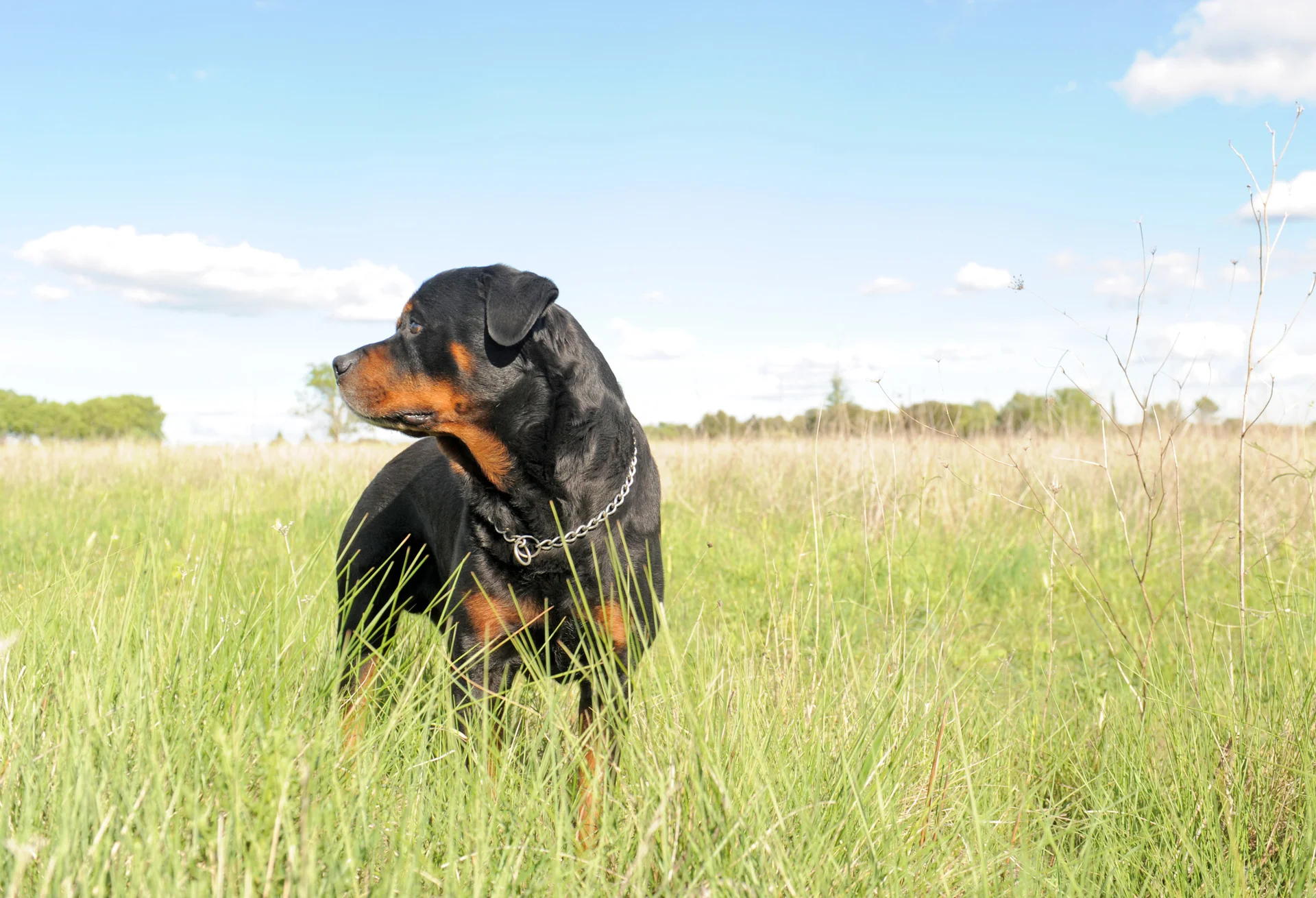
Rottweilers are one of the most capable, loyal, and trainable breeds alive — and one of the most commonly mishandled. Originally bred as cattle drovers in Rottweil, Germany, they were trusted to haul butchers' carts and guard earnings at market. That heritage produced a dog with serious physical power, sharp intelligence, and a deep instinct to work for its handler. Train them well and you have 80 to 135 pounds of composed, confident companionship. Skip training, and that same power and confidence becomes a liability.
In Dallas–Fort Worth, Rottweilers face a specific set of challenges: breed-specific insurance and HOA restrictions mean your dog's public behavior isn't just about convenience — it's about keeping your lease and your coverage. That makes structured training a necessity, not a luxury. We've trained hundreds of guardian breeds at Off Leash K9 Training Texas, and Rottweilers are among the most rewarding because once they trust the structure, they commit to it completely.
Understanding your Rottweiler
Rottweilers are working dogs who need a job. Without one, they invent their own — guarding the front window, body-blocking visitors, patrolling the fence line. That isn't aggression; it's an unemployed working dog filling the vacuum. The fix isn't dominance or correction — it's giving them a role they understand: follow the handler, hold the command, and trust that you have the situation covered.
Two traits define the breed. First, threshold sensitivity: Rottweilers don't ramp up gradually the way a Labrador does. They shift from calm to alert in a heartbeat, which means the training window between "relaxed" and "reacting" is narrow. Handlers who wait until their Rottweiler is already fixated have already lost the moment. We teach you to read the early signals — the head tilt, the weight shift forward, the ears pinning — and redirect before the dog crosses the line.
Second, handler loyalty. Rottweilers bond deeply with their primary person, which is beautiful but creates two problems: they can become overprotective of that person in public, and they may resist direction from other family members. Our training builds a relationship with the entire household, so every adult can walk and handle the dog confidently.
How we train Rottweilers
Confidence through structure
A confident Rottweiler doesn't need to prove anything — it already knows the rules and trusts that its handler is in charge. We build this through clear, consistent obedience: sit, down, place, heel, and recall, all practiced under graduated distraction until they become reflexive. The goal is a dog that looks to you for direction instead of making decisions on its own in high-pressure moments.
Threshold management
Because Rottweilers go from zero to alert so quickly, we spend significant time on threshold drills — teaching the dog to notice a trigger (doorbell, passing dog, stranger approaching) and choose neutrality instead of escalation. This is the single most important skill for a guardian breed living in a crowded metro like DFW, where daily walks mean joggers, strollers, other dogs, and skateboards.
Leash control at 100+ pounds
Rottweilers are dense, low-center-of-gravity pullers. A reactive lunge from a 120-pound Rottweiler can put an adult on the ground. We teach a structured heel that holds through distractions — not a loose "wander" walk, but a controlled position where the dog walks at your side and checks in. This is non-negotiable for a dog this powerful, and it's the behavior that makes public outings safe and comfortable.
Socialization and public neutrality
Most Rottweiler behavioral problems trace back to insufficient socialization during the critical window (8 to 16 weeks). If that window was missed, it's not too late — but the approach changes. We use controlled exposure: introducing new environments, people, and animals at a pace the individual dog can process, rewarding calm behavior, and building the dog's confidence that the world isn't a threat. The result is a Rottweiler that can walk through a farmers' market, sit at a patio restaurant, or greet your in-laws without anyone worrying.
Heat management in Texas
Rottweilers carry a dense double coat designed for German winters, not Texas summers. At 100+ degrees with DFW's humidity, they overheat faster than most owners realize. We schedule sessions for early morning or evening during June through September, use climate-controlled indoor facilities for intensive work, and teach owners the signs of heat stress (excessive panting, glazed eyes, heavy drooling, slowed response). Every board-and-train dog is monitored for hydration and temperature throughout the day.
Common Rottweiler behavior challenges in DFW
Door-rushing and territorial guarding
Your Rottweiler charges the front door when the doorbell rings, pins visitors with a hard stare, or body-blocks people from entering rooms. This is instinct, not disobedience — cattle dogs were bred to control movement. We replace that behavior with a reliable "place" command: when the door opens, the dog goes to its designated spot and stays there until released. No yelling, no wrestling a 100-pound dog into another room.
Leash reactivity toward other dogs
Many Rottweilers are fine with other dogs off-leash but become reactive on a leash because the leash removes their ability to choose distance. We address the underlying frustration, not just the surface behavior, teaching the dog to disengage calmly when it sees another dog on a walk. For dogs with genuine dog-selective aggression (not just leash frustration), we offer a dedicated reactive dog training program.
Resource guarding
Some Rottweilers guard food bowls, toys, or sleeping spots — especially males. This is manageable and common, but it needs professional attention, not YouTube advice. We teach the dog that hands near its food predict something better arriving, not something being taken away. The goal is a dog that looks up happily when you approach its bowl, because that's what safety looks like in a family home.
Programs for your Rottweiler
Every Rottweiler is different. A 4-month-old puppy needs a different plan than a 3-year-old with leash reactivity, and a first-time Rottweiler owner needs different support than someone on their third. We start with a free consultation and match the dog (and the owner) to the right program: board & train for the fastest results with the most real-world proofing, private lessons for owners who want to build the skills themselves, puppy training to get socialization right the first time, and off-leash training for Rottweilers ready for the next level. See full pricing.
Not sure which program fits?
Find your Rottweiler's training plan
Answer a few quick questions about your Rottweiler's age, behavior, and goals — free, about 60 seconds.
Take the free assessment →Rottweiler training FAQs
Are Rottweilers hard to train?
Rottweilers are actually one of the most trainable breeds — they were ranked 9th in Stanley Coren's intelligence rankings and consistently excel in obedience, tracking, and protection work. The challenge isn't intelligence; it's their strength and confidence, which mean sloppy training has bigger consequences than it would with a smaller, softer breed. With clear structure and consistent handling, Rottweilers learn quickly and retain commands reliably. Off Leash K9 Training Texas has trained hundreds of guardian breeds across Dallas–Fort Worth.
Are Rottweilers dangerous?
A well-socialized, properly trained Rottweiler is a calm, confident family dog. The breed's strength and protective instincts mean that untrained Rottweilers can become problematic — which is exactly why professional training matters more for this breed than most. At Off Leash K9 Training Texas, we specialize in building reliable obedience and public neutrality for guardian breeds in DFW, so your Rottweiler is safe, manageable, and a credit to the breed.
How much does Rottweiler training cost in Dallas?
At Off Leash K9 Training Texas, Rottweiler training runs from $650 for a 4-lesson private package to $2,200 for 2-week board & train, up to $5,800 for the 4-week Elite program. Guardian breeds often benefit from the immersive structure of board & train, but every dog is evaluated individually at a free consultation. Qualifying programs include lifetime refreshers.
Can Rottweilers be trained to be off-leash?
Yes — with the right training. Rottweilers are actually well-suited to off-leash work because they're naturally handler-focused and don't have the extreme prey drive or independent streak of, say, a Husky. Off-leash reliability requires solid recall, proofed under distraction, and a dog that defers to its handler in novel situations. That's the core of what Off Leash K9 Training Texas builds in every Rottweiler program.
At what age should I start training my Rottweiler?
As early as possible. Rottweiler puppies enter their critical socialization window at 8 weeks, and the habits formed between 8 and 16 weeks shape the adult dog's temperament more than anything else. Off Leash K9 Training Texas offers puppy training starting at 8 weeks, with a focus on socialization, bite inhibition, and household manners. For adolescent or adult Rottweilers, it's never too late — we regularly work with dogs age 1 to 8+ across Dallas–Fort Worth.
Ready to start with your Rottweiler? Veteran-owned, Dallas–Fort Worth, off-leash obedience that sticks.
📞 (972) 372-9225Free consultation with Off Leash K9 Training Texas.