Dog Scent Work Training in Dallas-Fort Worth
What is canine scent work training?
Off Leash K9 Training Texas offers canine scent work and nose work training in Dallas–Fort Worth, channeling your dog’s natural detection drive into structured search skills. Suitable for any breed or age. Veteran-owned, 4.9★ from 604 reviews. Call (972) 372-9225 to start.
Channel your dog's most powerful sense into a structured, mentally enriching skill. Off Leash K9 Training Texas offers complete scent work programs in DFW — from beginner enrichment to AKC Scent Work competition prep and full Board & Train detection. Taught by USMC veteran Justin Rie and a team that includes former military working dog handlers with real detection experience.
What's Inside This Guide
What is Dog Scent Work Training?
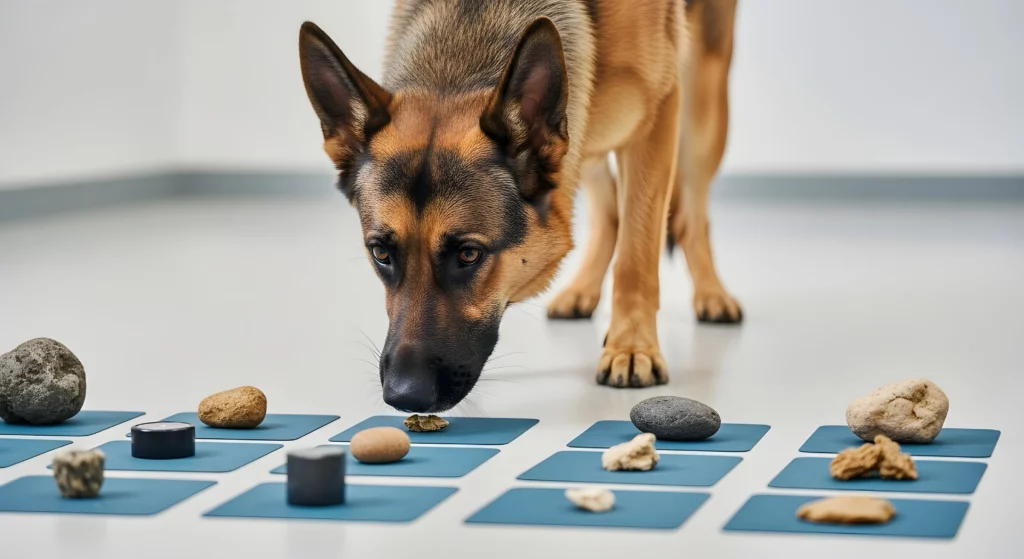
Scent work training teaches your dog to detect specific target odors (birch, anise, clove, cypress) and alert their handler when they find them. It is a canine sport based on professional detection dog work — the same methodology used to train explosives, narcotics, and search-and-rescue dogs, scaled for sport, enrichment, and competition.
Scent work (also called nose work or K9 nose work) is a canine activity based on the work of professional detection dogs. The dog learns to recognize specific target scents — most commonly the four essential oils used in AKC Scent Work competition: birch, anise, clove, and cypress — and to communicate to their handler when they have located the source. The handler reads the dog's alert and calls the find.
The activity scales beautifully across goals. At the entry level, a family dog can learn to find their meal hidden in one of six boxes — a 15-minute backyard game that produces a tired, fulfilled dog. At the competition level, dogs work timed searches across containers, interior rooms, exterior areas, and vehicles in nationally sanctioned trials. At the working level, the same foundational skills produce detection dogs that work for law enforcement, the military, conservation programs, and search-and-rescue teams.
Off Leash K9 Training Texas offers three structured programs covering the full spectrum: the Scent Work Starter Package ($300) for beginners, the Scent Work Proficient Package ($500) for owners building competition-ready skills, and the Scent Work Board & Train ($2,600) for dogs developing into fully independent search-and-alert workers. All three programs use the same balanced methodology that produces 10,000+ reliably trained dogs across the Dallas-Fort Worth metroplex.
Why Should You Try Scent Work With Your Dog?
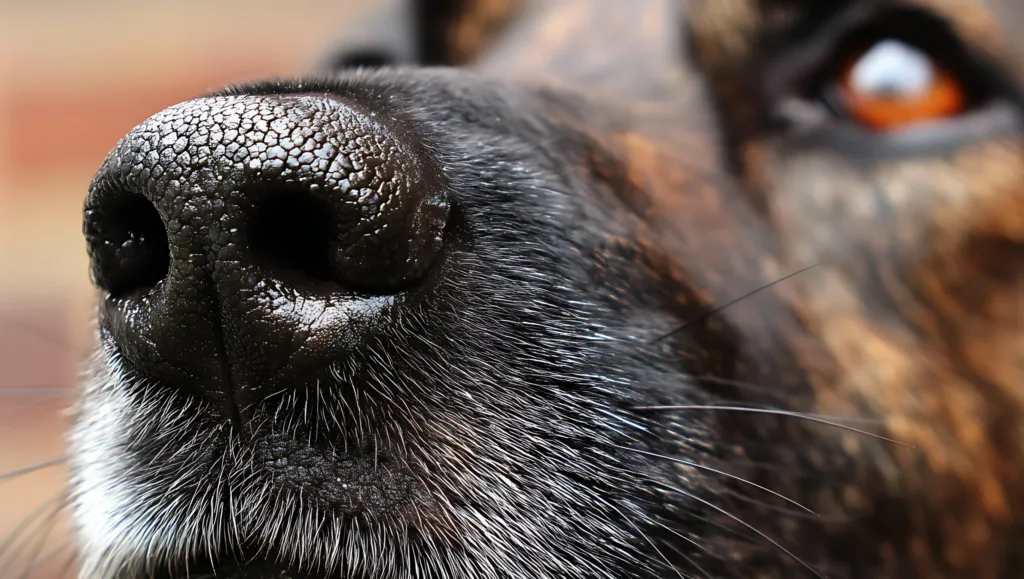
Fifteen minutes of scent work tires a dog more than an hour of physical exercise. Dogs have 220 million olfactory receptors vs 5 million in humans — using their nose is how they primarily experience the world. Channeling that drive into structured search produces a mentally fulfilled, emotionally settled, confident dog. Works for any breed, any age.
Most dog enrichment focuses on physical exercise: walks, runs, fetch, dog parks. Physical exercise matters, but it does not fulfill a dog's mind — and a dog that is physically tired but mentally bored will still chew the couch, dig the yard, and pace at the window. Scent work is the most efficient mental enrichment available because it activates the part of the brain dogs use most: their olfactory system.
A dog's nose contains approximately 220 million olfactory receptors compared to about 5 million in humans. The part of a dog's brain devoted to analyzing scent is roughly 40 times larger than the human equivalent. When a dog uses their nose intensely — really searches, really problem-solves an odor source — they engage cognitive resources that walking and fetch simply do not touch. Fifteen minutes of focused scent work produces a dog that lies down on their own afterward and sleeps deeply. Owners of high-drive working breeds (Belgian Malinois, German Shepherds, hunting breeds) routinely tell us that scent work changed their household more than any other single activity.
What Are the Specific Benefits of Scent Work?
Scent work delivers benefits that no other training discipline matches. Below are the outcomes we see consistently across our DFW clients:
| Benefit | What It Looks Like at Home |
|---|---|
| Mental fatigue | 15 minutes of scent work tires a dog more than a 60-minute walk. Dogs nap deeply afterward instead of pacing. |
| Confidence building | Shy and fearful dogs gain confidence because every search is a problem they solve successfully. The dog learns "I can figure things out." |
| Reactive dog calming | The focused mental work calms nervous systems. Many reactive dogs become noticeably steadier after 4–6 weeks of scent work. |
| Bond strengthening | Scent work is a true team activity — the dog leads, the handler reads. Trust deepens because the dog learns the handler will follow their information. |
| Rainy-day enrichment | Entirely indoor activity. When DFW summers hit 110°F or storms make walks impossible, scent work fills the gap. |
| Senior dog friendliness | Low physical impact. Senior dogs whose bodies cannot handle long hikes can still do scent work and stay mentally sharp. |
| Working breed outlet | High-drive breeds (Malinois, Shepherd, Doberman, hunting breeds) finally get a job. Destructive boredom behaviors usually disappear. |
Is Scent Work the Right Choice for an Anxious or Reactive Dog?
Yes — and it is often the single best activity for these dogs. Scent work works on reactive and anxious dogs for two reasons. First, the cognitive demand calms the nervous system the same way meditation calms a stressed person; sustained focus on a single problem regulates arousal. Second, scent work is solitary by design — the dog searches an empty room or container line on their own. There are no triggering stimuli (other dogs, strangers, vehicles), so anxious dogs can succeed in a low-stress environment and rebuild confidence. We have seen leash-reactive dogs become noticeably steadier after 6 weeks of consistent scent work, with no other intervention required.
Scent Work vs. Nose Work — Are They the Same Thing?
Yes and no. "Scent work" and "nose work" refer to the same training activity, but the terminology depends on the sanctioning organization. AKC uses "Scent Work." The NACSW (National Association of Canine Scent Work) uses "K9 Nose Work." Methodology is essentially identical. Most DFW dogs train in both styles and compete in either.
The naming conflict confuses a lot of new owners. The activity is the same — dog learns target odor, dog searches for odor source, dog alerts handler. The differences are organizational. The American Kennel Club (AKC) calls their version AKC Scent Work. The National Association of Canine Scent Work (NACSW), the older organization that founded the sport in the United States, calls their version K9 Nose Work. United Kennel Club calls theirs simply Nosework. Several other smaller organizations exist worldwide.
Practically, this means a well-trained scent work dog can compete in any of these venues with minimal adjustment. The target odors overlap heavily (birch is universal). The search disciplines are conceptually identical (container, interior, exterior, vehicle). The skills transfer. At Off Leash K9 Training Texas we use the term "scent work" because it matches the AKC vocabulary most American competitors use, but our methodology is equally applicable to NACSW K9 Nose Work and UKC Nosework competition. When a client asks "do you teach nose work?" the answer is yes — that is the same thing.
The Four Search Disciplines
Competition scent work uses four distinct search environments — your dog learns all four
Container Searches
Dog examines a line of boxes, bags, or tins and indicates which contains the target odor. Foundation discipline — usually the first one new teams master.
Interior Searches
Dog searches an indoor space (room, office, hallway) for hidden odor. Tests the dog's ability to work around furniture, baseboards, and elevated hides.
Exterior Searches
Dog searches an outdoor area for hidden odor. Wind, temperature, and ground surface dramatically affect how scent moves — the most variable discipline.
Vehicle Searches
Dog searches around the exterior of vehicles for hidden odor. Tires, wheel wells, bumpers, and fuel doors are common hide locations. The closest discipline to real detection work.
Advanced competition adds buried hide searches (odor concealed under loose substrate like sand, soil, or rocks) and handler discrimination exercises (dog distinguishes the handler's personal scent from a distractor scent). Our Proficient Package and Board & Train both prepare dogs for all six advanced variations. At Trial Element levels in AKC Scent Work, dogs progress from Novice through Excellent, Master, and Detective titles by demonstrating reliable performance across all disciplines.

The Four Target Odors in Scent Work
Scent work dogs learn four target odors derived from essential oils: birch, anise, clove, and cypress. AKC Scent Work uses all four. NACSW K9 Nose Work uses birch, anise, and clove. Birch is the universal starter odor — taught first and used in every organization. Dogs are conditioned through pairing the odor with food rewards over 4–8 sessions.
The four target odors used in scent work are all derived from concentrated essential oils. They are chosen because they are distinct, stable, safe for dogs, and unlikely to occur naturally in environments where competitions take place. A dog trained on these odors will not generalize to grocery store cinnamon or a candle in your living room — the specific essential oil signature is what they have been conditioned to find.
Birch
Universal starter odor. Used in every major scent work organization (AKC, NACSW, UKC). Distinctive, slightly minty wintergreen note.
Anise
Licorice-like aromatic. Added after birch is reliable. Used in AKC and NACSW competition. Strong and easy for dogs to identify.
Clove
Warm, spicy. Used in both AKC and NACSW. Often introduced once the dog reliably alerts on birch and anise.
Cypress
Added by AKC as a fourth target odor. Earthy, woody. Required for advanced AKC trial elements but not used in NACSW competition.
How Are Dogs Taught to Recognize the Target Odors?
Dogs learn target odors through a process called odor pairing. In the first sessions, the essential oil is placed directly beside high-value food — the dog smells birch, gets food, smells birch, gets food. Within 4–8 sessions, the dog associates the odor with the reward and begins searching for the odor on its own. From there, the food fades and the odor becomes the primary cue. The dog learns to indicate the source of the odor with an alert behavior (typically a trained sit, down, or focused stare), and the handler rewards the alert.
This is the same conditioning process used to train working detection dogs for narcotics, explosives, and disease detection — scaled down for the timeline and equipment of sport. A working detection dog at Lackland AFB learns on a similar timeline to a competition scent work dog at our Lewisville facility. The methodology is professional-grade.
Our DFW Scent Work Programs
OLK9 DFW offers three scent work programs: Starter Package ($300, 5 sessions) for beginners, Proficient Package ($500, 10 sessions) for competition prep, and Scent Work Board & Train ($2,600, 14 days) for dogs developing into fully independent searchers. All programs include equipment and use the same balanced methodology that produces 10,000+ reliably trained DFW dogs.
We structure our scent work offerings as a clear ladder: each program builds on the last, and dog/handler teams can advance through the levels as their goals expand. Many of our clients start with the Starter Package out of curiosity and end up competing in AKC Scent Work trials within 6–12 months. Others use scent work purely as weekly enrichment and never compete — both paths are equally valid.
Starter Package
Foundation introduction to scent work fundamentals. Perfect for dog owners exploring whether the sport is right for their dog.
- 5 lessons of 30 minutes
- Birch odor pairing
- Container search basics
- Handler reading skills
- Equipment provided
Proficient Package
Competition-ready skill building. The right program for owners targeting AKC or NACSW trial titles or building advanced enrichment routines.
- 10 lessons of 30 minutes
- Birch + anise + clove odors
- All 4 search disciplines
- Trial preparation drills
- Handler skill development
- Equipment provided
Scent Work Board & Train
Immersive 14-day program producing a fully independent search-and-alert dog. Designed for working dog candidates and serious competition teams.
- 14-day immersive program
- All target odors mastered
- Independent searches
- Reliable trained alert
- Owner turnover session
- Equipment provided
Complete Scent Work Pricing for Dallas-Fort Worth
Scent work training at Off Leash K9 Training Texas ranges from $300 to $2,600 depending on program depth. Below is the complete breakdown including session structure, what is taught, and what is included. All programs include the professional scent work equipment your team will need — odor tins, hide containers, target oils, and lead. You do not need to buy anything beforehand. Affirm financing is available on all packages.
| Program | Duration | Price | What's Included |
|---|---|---|---|
| Scent Work Starter Package | 5 lessons (30 min) | $300 | Birch odor pairing, container search foundations, handler reading basics, equipment provided |
| Scent Work Proficient Package | 10 lessons (30 min) | $500 | Birch + anise + clove, all 4 search disciplines, trial-prep drills, advanced handler skills, equipment provided |
| Scent Work Board & Train | 14 days | $2,600 | Independent search-and-alert development, all target odors, 1.5–3 hour owner turnover, equipment provided |
What Are the Cost-Per-Session Numbers?
Breaking down the math: the Starter Package equals $60 per session ($300 ÷ 5 sessions). The Proficient Package equals $50 per session ($500 ÷ 10 sessions), giving you better per-session value plus access to advanced content. The Board & Train equals approximately $185 per day for full-time professional training during the 14-day stay — less than most DFW dog daycares charge for basic supervision. For comparison, comparable scent work training at other DFW facilities runs $75–$120 per private session with equipment sold separately ($80–$150 for a starter kit).
Are Financing Options Available?
Yes. Off Leash K9 Training Texas partners with Affirm for flexible monthly financing on all scent work programs. The Proficient Package ($500) starts at approximately $46 per month over 12 months. The Board & Train ($2,600) starts at approximately $237 per month. Apply in minutes online with no impact to your credit score. Military, law enforcement, and first responder discounts are also available — call (972) 372-9225 for details.
How Does Scent Work Training Actually Work?
The process: (1) pair the target odor with high-value food rewards for 4–8 sessions until the dog associates odor with reward. (2) Hide the odor and let the dog search. (3) Reward the alert behavior (sit, down, or stare at source). (4) Build complexity through distance, height, environment, and distraction. The dog quickly learns to love the search.
Scent work training follows a clear sequence that any dog can complete. Here is what the first 4–8 sessions look like for a brand new team:
Phase 1 — Odor Pairing (Sessions 1–2)
We place a small amount of birch essential oil directly beside high-value food (typically real meat or cheese, not kibble). The dog approaches, smells the area, eats the food. The dog repeats this dozens of times. Within 1–2 sessions, the dog learns: "When I smell birch, food appears." This is classical conditioning — the same Pavlovian process used to train every working detection dog in the world.
Phase 2 — Source Drive (Sessions 2–4)
We start moving the food away from the odor source. The dog learns that the odor itself (not the food) is what they need to find. We reward the dog at the source as soon as they commit to it. By the end of Phase 2, the dog actively searches for the odor — not just the food. This is the moment the sport begins.
Phase 3 — Indication / Alert (Sessions 4–6)
We add the trained alert. Most dogs default to a focused stare, sit, or down at the source. We mark and reward the alert behavior so the dog knows: "Find the odor, hold the alert, get rewarded." Different organizations accept different alerts; we work toward whatever style fits the team's goals.
Phase 4 — Generalization (Sessions 6+)
Once the dog reliably finds and alerts on birch, we generalize the skill: different containers, different rooms, outdoor environments, vehicles, elevated hides, buried hides. Eventually we add the second target odor (anise), then the third (clove), then for AKC competitors, the fourth (cypress). Each new odor takes less time than the last because the dog now understands the game.
What Equipment Does Scent Work Training Use?
Standard scent work equipment includes: a 6-foot leash and well-fitted harness or collar (we provide both for the session), odor tins (small metal containers with a magnetic top, used to hold the essential oil), hide containers (cardboard boxes, plastic tins, or custom hide vessels), the essential oils themselves (birch, anise, clove, cypress), and high-value training rewards. All equipment is included with every OLK9 DFW scent work program — you do not need to buy or bring anything for your sessions.
What Is AKC Scent Work Competition?
AKC Scent Work is the American Kennel Club's sanctioned scent work competition program. Dogs progress through four levels (Novice, Advanced, Excellent, Master) across four elements (Container, Interior, Exterior, Vehicle) plus Handler Discrimination and Buried Hide. Titles are earned by completing qualifying runs. Open to all dogs — purebred or mixed-breed.
AKC Scent Work is the most popular scent work competition format in the United States. The American Kennel Club launched the program in 2017 and it now hosts thousands of trials annually. The Dallas-Fort Worth area hosts multiple AKC Scent Work trials each year through local clubs and training centers.
How Are AKC Scent Work Titles Earned?
AKC Scent Work titles are earned by completing qualifying runs across four progressive levels in each element. The four levels are Novice, Advanced, Excellent, and Master — plus the prestigious Detective title for dogs that complete all advanced elements. Each level requires three qualifying runs from at least two different judges. Dogs and handlers work as a team; both must perform their roles correctly for the run to qualify.
Which Target Odors Are Used in AKC Scent Work?
AKC Scent Work uses all four target odors — birch, anise, clove, and cypress — depending on the trial level. Novice dogs work birch only. Advanced introduces anise. Excellent adds clove. Master dogs must find all four odors during a run, and Detective-level competitions add hide combinations and complex environmental challenges. Our Proficient Package covers the first three odors; the Board & Train adds cypress for AKC Master and Detective candidates.
Can Any Dog Compete in AKC Scent Work?
Yes — AKC Scent Work is open to all dogs, including mixed breeds, rescue dogs, and dogs of any age. This is one of the most inclusive competitive dog sports in existence. Reactive or anxious dogs can compete because each search is conducted with only the dog, the handler, and the judge present. Senior dogs can compete because the physical demands are minimal. Three-legged dogs, blind dogs, and deaf dogs all earn AKC Scent Work titles every year.
What Is NACSW K9 Nose Work?
NACSW (National Association of Canine Scent Work) is the original American scent work organization, founded in 2006 by professional detection dog trainers. NACSW competition uses three target odors (birch, anise, clove) and progresses through NW1 through NW3 titles plus Elite levels. Considered the most technically rigorous scent work venue in the US.
The National Association of Canine Scent Work (NACSW) founded the sport of K9 Nose Work in 2006. The organization was created by professional detection dog trainers who wanted to bring the cognitive benefits and trust-building of detection work to companion dogs. NACSW competition is widely considered the most technically demanding scent work venue in the United States — judges are exacting, environmental challenges are unpredictable, and titles are earned slowly.
How Does NACSW Competition Structure Work?
NACSW titles progress through NW1, NW2, NW3, and then into the Elite titles (Elite 1, 2, 3, 4 plus the prestigious Summit title). Dogs work the same four elements as AKC (containers, interiors, exteriors, vehicles) but with greater environmental variability and more complex hide placements at advanced levels. A single qualifying NW3 or higher run requires a near-perfect performance — there is no room for partial credit.
Which Should I Train For — AKC or NACSW?
Both — and you do not have to choose. The foundational training is essentially identical. Our Proficient Package and Board & Train prepare dogs and handlers for either venue. Many DFW teams compete in both organizations, with AKC providing more accessible entry-level titling and NACSW providing greater long-term competitive depth. The decision usually comes down to which trials are geographically convenient and which community of competitors a team enjoys.
What Are the Best Breeds for Scent Work?
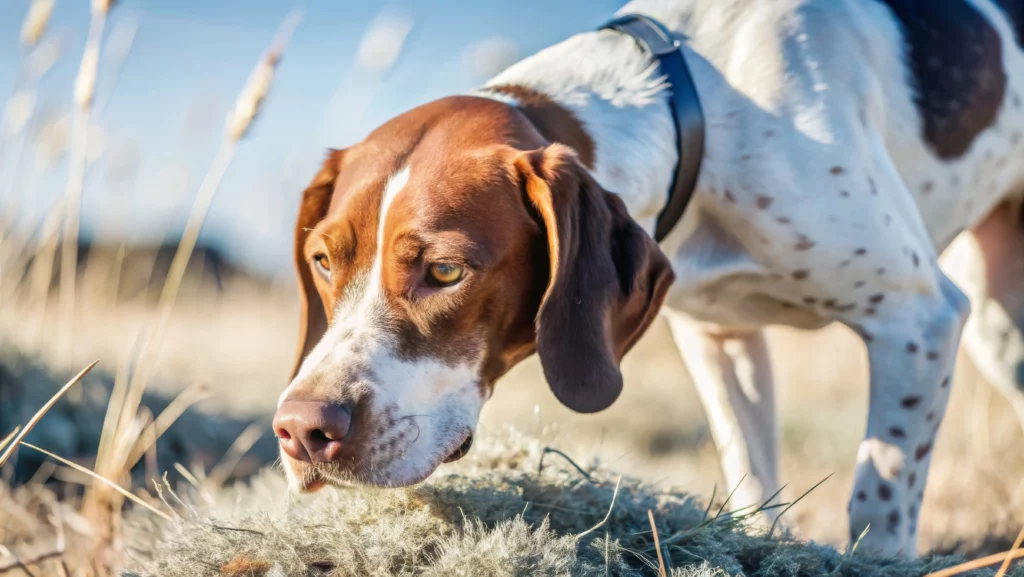
Every breed can do scent work — even brachycephalic breeds like Bulldogs and Pugs. Hunting breeds (Beagles, Labs, Spaniels, Pointers) have natural scenting advantages. Working breeds (Malinois, German Shepherds, Dobermans) excel at competition. But scent work uses the dog's natural drive — if your dog has a nose, they can do scent work.
One of the most common questions we get is whether a particular breed will be "good at" scent work. The honest answer: every breed succeeds, and breed matters less than individual drive and temperament. We have certified competition titles on Beagles, Bloodhounds, Labrador Retrievers, German Shepherds, Belgian Malinois, and standard breeds — but also on Chihuahuas, Yorkies, mixed-breed rescues, and three-legged dogs. The activity scales to the dog in front of you.
Which Breeds Have Natural Scenting Advantages?
Hunting and scent-hound breeds were genetically selected for olfactory work over generations and tend to have anatomical advantages: longer muzzles, larger olfactory bulbs, and behavioral drives that match scent searching. The classic high-performers include:
- ✓Beagles, Bloodhounds, Basset Hounds — scent hounds bred for the work
- ✓Labrador Retrievers, Golden Retrievers, Spaniels — hunting retrievers with strong natural scenting
- ✓German Shorthaired Pointers, Vizslas, Weimaraners — pointing breeds with extensive scenting heritage
- ✓German Shepherds, Belgian Malinois, Dutch Shepherds — working breeds used widely in professional detection
- ✓Border Collies, Australian Shepherds — herding breeds with high drive and problem-solving capacity
Can Brachycephalic Breeds Like Bulldogs and Pugs Do Scent Work?
Yes. Brachycephalic breeds (Bulldogs, Pugs, Boston Terriers, French Bulldogs, Boxers) have shorter nasal passages and can experience faster scent fatigue, but they absolutely succeed at scent work. We adjust session duration and environmental conditions for these breeds — shorter searches, cooler rooms, more rest breaks — and they earn AKC titles regularly. Several of our most enthusiastic scent work clients are French Bulldogs.
Can Puppies and Senior Dogs Do Scent Work?
Yes — scent work has the widest age range of any dog sport. Puppies as young as 10 weeks can begin foundation odor pairing. Senior dogs in their teens regularly continue competing. Because the activity is low-impact and entirely mental, it is the most age-flexible training discipline available. Many dogs do scent work for their entire lives.
What Age Can a Puppy Start Scent Work?
Puppies can begin foundation odor pairing as early as 10 weeks old. The sessions are short (5–10 minutes), the work is purely fun (find food, get food), and the puppy is building positive associations with scent searching before any pressure exists. Starting scent work young produces dogs that approach the activity with extraordinary confidence as adults. We frequently combine scent work introduction into our AKC S.T.A.R. Puppy Program ($450) and Puppy Board & Train ($850) for owners interested in early enrichment.
Can Senior Dogs Start Scent Work?
Absolutely — and they often thrive at it. Senior dogs whose bodies cannot handle long walks or rough play can still do 15-minute scent work sessions and stay mentally engaged. Many veterinarians recommend scent work specifically for cognitive maintenance in aging dogs; the focused mental work appears to help preserve cognitive function the same way puzzles and learning help humans. Our oldest first-time scent work student was 13 years old, and within 4 sessions she was finding birch hides faster than dogs a quarter her age.
Can Reactive or Anxious Dogs Do Scent Work in Group Classes?
Reactive and anxious dogs work scent work privately at OLK9 DFW — one team, one trainer, no other dogs present. This is by design, not a limitation. Scent work for reactive dogs needs to happen in a low-stress environment so the dog can succeed without trigger exposure. The skills they build (focus, problem-solving, confidence) often transfer to better behavior in everyday life, but the training sessions themselves are quiet and controlled.
Why Our Trainers Are Qualified to Teach Scent Work
Real detection experience — not just hobby-level scent work
Most DFW scent work programs are taught by trainers whose only credential is having competed in scent work themselves. Our team is different. Off Leash K9 Training Texas employs multiple former military and law enforcement K9 handlers who trained working detection dogs in narcotics, explosives, gun detection, and patrol work before joining our team. The methodology we teach to companion dog owners is the same methodology used to train working detection dogs at Lackland Air Force Base — scaled appropriately for sport and enrichment, but built on professional foundations.
Specific Scent Work Credentials on Our Team
Our credential stack relevant to scent work includes Odor Detection Certified through the International Association of Canine Professionals (IACP), Human Tracking & Trailing Certified through IACP, multiple former USMC and USAF K9 Handlers with combat tracking and detection experience, and direct detection dog training history in narcotics, explosives, gun detection, and patrol from team members like Kate Thompson (USMC veteran with 6+ years in law enforcement detection) and Brandon (former USAF K9 Handler with 12+ years in military working dogs). When you train scent work with us, you are working with people whose dogs have actually found things that mattered.
DFW Areas We Serve
Scent work training across the entire Dallas-Fort Worth metroplex
Off Leash K9 Training Texas is located at 101 S Railroad St, Suite 7, Lewisville, TX 75057 — centrally positioned to serve the entire Dallas-Fort Worth metroplex. We provide in-facility scent work sessions at our Lewisville training center, private lessons for clients from surrounding suburbs, and Board & Train accommodations for the full 14-day immersive program. Our service area covers Allen, Carrollton, Dallas, Denton, Flower Mound, Fort Worth, Frisco, Garland, Highland Park, Plano, Preston Hollow, University Park, Southlake, plus McKinney, Prosper, Celina, Little Elm, The Colony, Coppell, Grapevine, Colleyville, Euless, Bedford, Arlington, Irving, Richardson, Mesquite, and all surrounding North Texas communities.
Click a city for area-specific dog training information:
Mon–Fri 8 AM–6 PM · Sat 9 AM–6 PM · Sun 10 AM–5 PM · HABLAMOS ESPAÑOL
Scent Work Training FAQ — Dallas-Fort Worth
Answers to the questions DFW dog owners ask most about scent work
Scent work training at Off Leash K9 Training Texas ranges from $300 (5-session Starter Package) to $2,600 (14-day Scent Work Board & Train). The middle-tier Proficient Package is $500 for 10 sessions. All programs include professional equipment. Affirm financing is available on all packages.
Same activity, different organizational names. AKC calls it "Scent Work." NACSW calls it "K9 Nose Work." UKC calls it "Nosework." The methodology, target odors, and search disciplines are essentially identical. A dog trained at OLK9 DFW can compete in any of these venues with minimal adjustment.
The four target odors are birch, anise, clove, and cypress — all derived from concentrated essential oils. AKC Scent Work uses all four. NACSW K9 Nose Work uses birch, anise, and clove (no cypress). Birch is the universal starter odor taught first in every organization.
Foundation odor recognition takes 4–8 sessions for most dogs. Trial-ready performance in one discipline takes 2–4 months of consistent practice. Full competition readiness across all four disciplines takes 6–12 months. The 14-day Scent Work Board & Train compresses this timeline by providing intensive daily sessions in a dedicated training environment.
Yes — scent work is one of the best activities for reactive and anxious dogs. All sessions at OLK9 DFW are private (one team, one trainer), so there are no trigger stimuli. The focused mental work calms the nervous system, and many reactive dogs become noticeably steadier after 4–6 weeks of consistent scent work.
Every breed succeeds at scent work. Hunting and scent-hound breeds (Beagles, Bloodhounds, Labradors, Pointers, Spaniels) have natural scenting advantages. Working breeds (Malinois, German Shepherds, Dobermans) excel in competition. But mixed breeds, brachycephalic breeds (Bulldogs, Pugs), and toy breeds all earn AKC Scent Work titles every year.
Puppies can begin foundation odor pairing as early as 10 weeks old. Sessions are short (5–10 minutes), purely fun, and build positive associations before any pressure. Starting young produces adult dogs with extraordinary confidence in scent searching. We integrate scent work into our AKC S.T.A.R. Puppy Program and Puppy Board & Train.
Absolutely — senior dogs often thrive at scent work. The activity is low physical impact, mentally engaging, and many veterinarians recommend it for cognitive maintenance in aging dogs. Our oldest first-time scent work student started at 13 years old and was finding hides faster than dogs a quarter her age within 4 sessions.
You do not need to buy anything beforehand. All OLK9 DFW scent work programs include the professional equipment your team will need — odor tins, hide containers, target essential oils (birch, anise, clove, cypress), 6-foot leash, harness or collar, and high-value training rewards. Equipment is included in every program price.
The foundation is similar but the application differs. Sport scent work teaches dogs to find specific target odors (birch, anise, clove, cypress) in controlled environments. Search-and-rescue (SAR) training teaches dogs to find live human scent in wilderness or disaster environments. Sport scent work is excellent foundation for dogs that may later transition to SAR or detection work.
AKC Scent Work uses four target odors (birch, anise, clove, cypress) and progresses through Novice/Advanced/Excellent/Master/Detective titles. NACSW uses three odors (birch, anise, clove) and progresses through NW1/NW2/NW3 and Elite titles. NACSW trials are typically more technically demanding; AKC trials are more accessible for entry-level competitors. Many DFW teams compete in both organizations.
Yes — HABLAMOS ESPAÑOL. Off Leash K9 Training Texas provides bilingual scent work training for the diverse Dallas-Fort Worth community. Visit our Spanish-language page or call (972) 372-9225.
Off Leash K9 Training Texas is located at 101 S Railroad St, Suite 7, Lewisville, TX 75057 and offers scent work training across the entire DFW metroplex. Most sessions take place at our Lewisville training facility. Private lessons and Board & Train options are also available. We serve Allen, Carrollton, Dallas, Denton, Flower Mound, Fort Worth, Frisco, Garland, Highland Park, Plano, Preston Hollow, University Park, Southlake, plus all surrounding North Texas communities.
Yes — destructive behavior is almost always a symptom of mental under-stimulation, not lack of physical exercise. Scent work delivers more mental fatigue per minute than any other dog activity. Most owners of high-drive breeds (Malinois, German Shepherds, hunting breeds) report dramatic reductions in chewing, digging, and pacing after adding 2–3 scent work sessions per week.