
Doberman Pinscher Training in Dallas–Fort Worth
Who trains Dobermans in Dallas–Fort Worth?
Off Leash K9 Training Texas trains Doberman Pinschers across Dallas–Fort Worth — channeling their intelligence, speed, and protective instincts into precise, confident obedience that works in public, at home, and off-leash. The Doberman was the official war dog of the United States Marine Corps, and as a veteran-owned training company, we understand working-dog mentality. Rated 4.9★ from 606 reviews, 10,000+ dogs trained since 2014. Private lessons from $650; board & train from $2,200. Call (972) 372-9225.
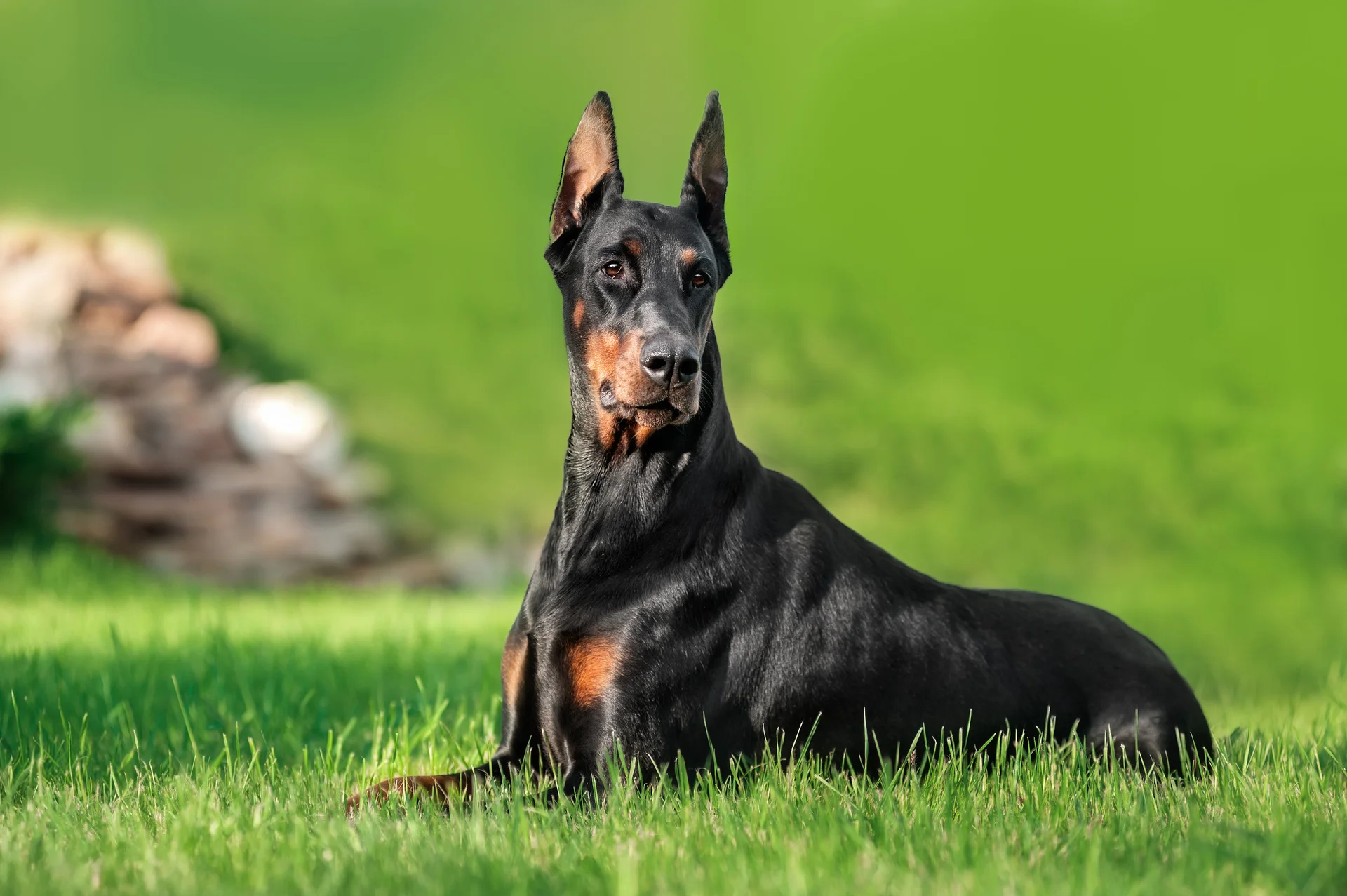
Doberman Pinschers are the athletes of the dog world — lean, fast, wickedly smart, and wired to their handler at a depth most breeds never reach. Louis Dobermann bred them in 1890s Germany as personal protection companions: a dog sharp enough to read a threat, brave enough to act, and bonded enough to stand down the moment its handler says so. That combination of intelligence, loyalty, and controlled power is what makes a trained Doberman one of the most impressive dogs alive — and what makes an untrained one a serious liability.
In Dallas–Fort Worth, Dobermans are one of the breeds most commonly affected by insurance restrictions and HOA breed bans. This means your Doberman's public behavior isn't just about quality of life — it can determine whether you keep your homeowner's policy and your lease. A calm, obedient Doberman that walks politely past neighbors and ignores distractions isn't just well-trained; it's your strongest argument against breed discrimination. That's the dog we build at Off Leash K9 Training Texas.
Understanding your Doberman
Dobermans are often mischaracterized as "aggressive guard dogs." In reality, they're one of the most sensitive, handler-dependent breeds in existence. A Doberman who is anxious, reactive, or difficult is almost always reflecting its handler's uncertainty, inconsistent training, or insufficient socialization — not some innate aggression. Understanding this sensitivity is the single most important thing a Doberman owner can do, because it changes everything about how you approach training.
Three traits define how we train Dobermans at Off Leash K9 Training Texas:
Handler sensitivity. Dobermans read your body language, vocal tone, breathing patterns, and emotional state with an accuracy that borders on unsettling. Raise your voice in frustration and a Labrador shakes it off; a Doberman internalizes it and becomes uncertain. This sensitivity is the breed's superpower in training — they respond to subtle cues and learn from minimal correction — but it means harsh methods that "work" on tougher breeds will damage a Doberman's confidence and create the very anxiety-based behaviors you were trying to fix. Every session at Off Leash K9 Training Texas is built on clear, calm, consistent communication.
Velcro bonding. Dobermans are sometimes called "velcro dogs" because they bond to their primary person with an intensity that can become problematic. They follow you room to room, lie at your feet, position themselves between you and strangers, and become distressed when separated. This deep bond is one of the breed's most appealing traits — but it creates a genuine vulnerability to separation anxiety, which is the most common behavioral issue in Dobermans. We address it proactively in every training program, building the dog's confidence that being alone is safe.
Protective instinct without training. Dobermans have a natural protective instinct that does not need to be trained — it needs to be managed. An unsocialized Doberman will decide on its own who is a threat and who isn't, and it will be wrong far more often than it's right. Proper socialization and obedience training gives the dog a framework: the handler decides what's a threat, and the dog follows the handler's lead. This produces a Doberman that's appropriately alert without being reactive, protective without being aggressive, and safe in public without being a liability.
How we train Dobermans
Precision obedience
Dobermans thrive on precision. They're fast learners who enjoy the clarity of crisp commands and immediate feedback — sit means sit, not sit-then-shuffle-then-lie-down. We train obedience at a higher standard with Dobermans than with most breeds because they're capable of it and because their size and speed demand it. A sloppy "come" from a 90-pound Doberman closing ground at 30 mph isn't a recall — it's a collision. We build commands that are sharp, reliable, and hold under pressure.
Socialization and public confidence
The critical socialization window for Dobermans (8 to 16 weeks) shapes the adult dog's temperament more dramatically than in most breeds. A well-socialized Doberman is confident, friendly, and calm in public. A poorly socialized one is fearful, reactive, and unpredictable — which is dangerous in a dog this fast and strong. We expose Dobermans to a wide range of people, environments, surfaces, sounds, and situations at a pace the individual dog can process, building genuine confidence instead of flooding the dog with overwhelming experiences.
Separation anxiety prevention
Because Dobermans bond so intensely to their handlers, separation anxiety is the breed's most common behavioral challenge. It manifests as destructive behavior (door frames, crate bars, window blinds), excessive vocalization, pacing, drooling, and in severe cases, self-harm. We build independence into every Doberman training program from day one: teaching the dog to hold a "place" command while the handler moves around the house, then leaves the room, then leaves the home — gradually extending duration and building the dog's confidence that separation is temporary. Combined with crate conditioning, enrichment, and exercise, most Dobermans learn to relax alone within 3 to 4 weeks.
Controlled protection instinct
We don't train personal protection — that's a specialized discipline beyond standard obedience. What we do is teach the Doberman to defer to its handler on threat assessment. When a stranger approaches your door, the dog looks to you for direction instead of making its own decision. When you greet a friend warmly, the dog reads your body language and relaxes. When you tense up, the dog goes alert but holds position until directed otherwise. This handler-referencing behavior is the difference between a protection dog and a liability dog, and it's built through thousands of repetitions of the dog checking in and being rewarded for trusting your judgment.
Off-leash reliability at speed
Dobermans are one of the fastest domestic dog breeds, capable of sustained sprinting at 30+ mph. Off-leash obedience for a Doberman isn't the same as off-leash obedience for a Bulldog — the recall has to work at speed, from distance, with the dog in full drive. We proof recall using long lines, high-value rewards, and progressive distraction at DFW parks, trails, and neighborhoods. The result is a Doberman that can run full-out, hear the recall, and turn on a dime to come back — not because it's been forced to, but because coming back has always been the best outcome.
Common Doberman challenges in DFW
Anxiety-based reactivity
Reactive Dobermans — lunging, barking, spinning on leash — are almost always anxious, not aggressive. The reactivity is a coping mechanism: "I'll scare that thing away before it scares me." This is the opposite of confidence. We address the underlying anxiety through controlled exposure, counter-conditioning, and confidence-building exercises that teach the dog it can handle novel situations without escalating. For dogs with severe reactivity, we offer a dedicated reactive dog training program with behavior-modification protocols.
Resource guarding in multi-dog homes
Dobermans in multi-dog households sometimes develop resource guarding — protecting food bowls, favorite sleeping spots, or preferred humans. This is manageable but needs early, consistent intervention. We teach structured feeding protocols, space management, and "trade-up" exercises that make the dog associate human hands near its resources with something better arriving, not something being taken. In DFW's suburban homes where multiple dogs share space, this is a quality-of-life issue for the entire household.
Jumping and demand behaviors
A jumping Doberman is not a small problem — they're tall, lean, and athletic enough to put paws on an adult's shoulders. Combined with their intensity and speed, enthusiastic greetings can knock people down, terrify visitors, and reinforce the "scary dog" stereotype. We replace jumping with an incompatible behavior — typically an automatic sit on approach — and teach the dog that calm greetings earn the attention it wants. For families with children or elderly visitors, this is often the first behavior we address.
Noise sensitivity and storm anxiety
Dobermans are disproportionately sensitive to loud noises — thunderstorms, fireworks, construction — because their overall sensitivity amplifies sound-related stress. DFW's severe storm season (March through June) and Independence Day celebrations are annual triggers. We address noise anxiety through desensitization protocols (graduated sound exposure with positive reinforcement), safe-space conditioning, and management strategies that reduce the dog's stress during events that can't be controlled.
Programs for your Doberman
Every Doberman is an individual. A confident 5-month-old puppy discovering its speed needs a different plan than a 2-year-old rescue with separation anxiety and leash reactivity. We start with a free consultation and match the dog to the right program: board & train for the most intensive, immersive foundation (and for addressing separation anxiety in a structured environment), private lessons for owners who want to build their handling skills alongside their dog, puppy training to nail the critical socialization window, and off-leash training for Dobermans ready for full freedom. See full pricing.
Not sure which program fits?
Find your Doberman's training plan
Answer a few quick questions about your Doberman's age, behavior, and goals — free, about 60 seconds.
Take the free assessment →Doberman training FAQs
Are Doberman Pinschers easy to train?
Dobermans are one of the easiest breeds to train in terms of intelligence and willingness — they're ranked 5th in Stanley Coren's canine intelligence rankings, behind only Border Collies, Poodles, German Shepherds, and Golden Retrievers. The key is their sensitivity: they respond brilliantly to clear, positive training and poorly to harsh correction. With the right approach, a Doberman learns faster and retains more reliably than almost any breed. Off Leash K9 Training Texas specializes in the calm, structured methods that Dobermans thrive on.
Do Dobermans have separation anxiety?
Dobermans are one of the breeds most prone to separation anxiety because they bond so deeply to their handlers. Signs include destructive behavior when alone, excessive vocalization, pacing, drooling, and attempting to escape. This is manageable with proper training — Off Leash K9 Training Texas builds independence and confidence into every Doberman program, including graduated alone-time training, crate conditioning, and enrichment strategies. Most Dobermans improve significantly within 3 to 4 weeks.
Are Dobermans good family dogs?
Well-socialized, properly trained Dobermans are excellent family dogs — loyal, affectionate, playful, and naturally protective of their household. They're energetic enough to keep up with active families and sensitive enough to be gentle with children when properly introduced. The key is early socialization and consistent obedience training so the dog's protective instincts are managed by the handler, not running on autopilot. Off Leash K9 Training Texas works with DFW families to build Dobermans that are safe, reliable, and a joy to live with.
How much does Doberman training cost in Dallas?
At Off Leash K9 Training Texas, Doberman Pinscher training runs from $650 for a 4-lesson private package to $2,200 for 2-week board & train, up to $5,800 for the 4-week Elite program. Dobermans with separation anxiety or reactivity often benefit from board & train, which provides the structured, consistent environment they need to build new habits. Qualifying programs include lifetime refreshers.
Can Dobermans be off-leash?
Yes — Dobermans are one of the best breeds for off-leash obedience. They're naturally handler-focused, highly responsive to commands, and fast enough to make off-leash work exhilarating. The challenge is proofing recall at the speeds a Doberman runs (30+ mph) and building impulse control around triggers that activate their protective or chase instincts. Off Leash K9 Training Texas proofs off-leash commands in real DFW environments until the behavior is reflexive, not negotiable.
Ready to start with your Doberman? Veteran-owned, Dallas–Fort Worth, off-leash obedience that sticks.
📞 (972) 372-9225Free consultation with Off Leash K9 Training Texas.